Showing posts with label pinxterflowers. Show all posts

Tuesday, January 31, 2023

On my old profile

I've been thinking about rewriting my profile, and editing some other parts of this blog, but I wanted to keep some of the information around, so I'm posting the current version here:


I am a Durham native and graduated from UNC-Chapel Hill after studying biology and anthropology.  I am distantly related to Irish bourgeois democratic revolutionary Thomas Francis Meagher, who was also a US general during the Civil War and an acting governor of territorial Montana.  I was a member of AML, which dissolved around 2008 – 2012.  I worked with USMLO's Voice of Revolution newspaper locally for several years without being a member.  I joined the NC Green Party several years ago for electoral work.  Unless otherwise stated, my posts don't represent any group.  My profile image is an uncommon pinxterflower that grew near the edge of RTP in Durham for probably more than 20 years, but that bush and the entire population were seemingly killed by Duke Energy, though they knew about the flowers.  The next nearest pinxterflowers I know of are miles away, so unless there are surviving sprouts or seeds, these rare azaleas are probably not going to return there anytime soon (see my 9/8/2018 DS post).  I reserve the copyright on content I created while other content is posted with permission or under fair use.  I rarely check the listed email. 


I think previous versions gave a few different personadetails, covered other groups I worked with and historical figures, and advocated policies.  Most of the time it was minimal and is longer now I'm not sure about posting the other profiles again here, though they are still online.  I had to check to see what I had posted previously.

I'm not sure if these versions were all actually posted:


I was born and raised in Durham. I studied biology and anthropology at UNC-Chapel Hill and since then I have done both blue and white collar work, for government and private employers. My profile photo shows Phat Ryan/Rockin' Ruben, the cardinal sculpture in Durham's Central Park.


This might have been posted February 8, 2008:


I was born and raised in Durham. As a communist, I am for a revolutionary democratic working class government that will steadily build socialism. Some steps would be to expropriate Big Business, turning it over to its workers to run within a democratically planned and sustainable economy, end “free trade,” encourage cooperatives, and nationalize land. Government should be open, the anti-democratic “national security state” should be smashed, the people armed, the legislature supreme, and officials should be elected, recallable, and paid like workers. It must support self-determination for all nations, including those in the USA, like Puerto Rico. I support enlarging the Bill of Rights, ending the second class citizenship of LGBT people and other minorities, abolishing the death penalty, preserving biodiversity, fighting climate change with renewable and nuclear power, space development, legalizing industrial hemp and ending the “War on Drugs.” 

I am an anti-revisionist Marxist-Leninist, supporting revolutionary communist leaders such as Marx, Engels, Lenin, Stalin, Enver Hoxha (Albania), and Bill Bland (UK) [I could add AML's Hari Kumar]. I also admire bourgeois revolutionaries such as Thomas Jefferson.


I was born and raised in Durham and studied biology and anthropology at UNC-Chapel Hill and since then have worked for private and government employers. I am distantly related to Irish bourgeois democratic revolutionary Thomas Francis Meagher, who was also a Union [or Federal] general during the Civil War and a territorial governor of Montana. I was a member of Alliance Marxist-Leninist, but since its dissolution in about 2008 I have worked with groups such as USMLO and PCUSA, though I am not a member. In electoral politics I support the Green Party, the closest thing to a left alternative in North Carolina, though punitive rules have kept it off the ballot. This blog covers a variety of issues, but I am most interested in conservation, labor and economic issues, civil liberties and democratic rights, and fighting imperialism, beginning with US imperialism. My profile photo shows appropriately crimson Phat Ryan/Rockin' Ruben, the cardinal sculpture in the Durham Central Park. My email is listed, but I don't check it very often, so if I reply, it might take a long time.  


For several years I used a late December 2009 image of 'appropriately crimson' Phat Ryan/Rockin' Ruben (there was a dispute about the name), a sculpture of a male Northern cardinal in Durham Central Park, for my profile.  I think that was the first image.  Cardinals, also called "red birds" or "redbirds," though only adult males are so showy in scarlet and black, are North Carolina's state bird.  

The current image, added a few years ago, shows the large, old, possibly ill-fated pinxterflower near Research Triangle Park blooming one evening in late April 2013.  I've thought about posting a photo essay of pinxterflowers I know of in the Triangle in bloom some spring.  The flowers remind me of East Asian higanbana/red spider lilies and pink magic lilies (genus Lycoris, in the Amaryllis family, as apparently are daffodils, soon to bloom or maybe already starting here, since it was an unusually mild January).  I might add to this post later on.  


The Phat Ryan/Rockin' Ruben male cardinal sculpture in Durham Central Park around Christmas 2009 ©.
The Phat Ryan/Rockin' Ruben male cardinal sculpture in Durham Central Park around Christmas 2009 ©.


A large pinxterflower, Rhododendron periclymenoides, a native deciduous azalea, flowering near RTP in Durham in late April 2013 ©.
large pinxterflower, Rhododendron periclymenoidesa native deciduous azalea, flowering near RTP in Durham in late April 2013 ©.


Monday, February 08, 2021

The starry sky stolen and estranged (and some notices)

A crescent Moon and a planet, probably Venus, seen from Lowes Grove after sunset in April 2018; a former Citgo gas station is on the left and a BP is on the right. ©

Despite light pollution being covered in Durham's UDO (Unified Development Ordinance dsc.durhamnc.gov/175/Development-regulations ) it remains abundant and must be increasing. In parts of Durham a clear winter night sky is black and sparkles with some of the brightest and most well-known constellations and on summer nights the Milky Way is just barely perceptible overhead, marked by the three avian constellations forming the Summer Triangle, high in the sky, but far fewer stars are visible than in rural parts of North Carolina, and few if any places in the state are truly dark. Unnecessary and wasted light can harm other species and human health and safety, besides ruining the night sky and wasting electricity, largely generated by polluting or otherwise damaging sources of energy.


When there are low clouds the problem in Durham becomes more visible. One night several years ago, around maybe 10 or 11pm, low clouds over southern Durham were intensely orange, as seen from the edge of Chapel Hill, and I heard that people called 911 thinking there was a fire. Circles of white light can sometimes be seen reflected above Research Triangle Park and commercial areas and when it is clear all of those photons still go up into the sky, where they bounce off air pollution, dust, and water vapor, making the sky brighter than it would be naturally, washing out the stars. From fall through spring low clouds turn bright orange for part of the night in one area. The source seems to be brightly lit greenhouses at the Park Research Center (104 TW Alexander Drive, apparently housing several companies, with the entire complex owned by an entity in New York City), across the road from RTP proper. The greenhouses are visible, an amber glow through the bare trees, across South Alston Road and the Burdens Creek valley from what is now called Falls Pointe at the Park (100 Cascade Falls Lane off of South Alston, www.fallspointeattheparkapartments.com see a previous post: www.durhamspark.blogspot.com/2018/12/burdens-creek-bluff-and-surrounding.html ). The light pollution is bright enough that branches are clear in photos taken with a plain digital camera miles away. At the Stonesthrow Apartments, right next to the greenhouses, the reflected light is so bright that it is possible to read a book by it. Surely this has biological effects and pollutes the common night sky for everyone over a large part of south Durham. Durham officials measured the light levels, but as I recall the light is considered indoors and therefore not covered by the UDO, despite the walls and ceilings being clear glass, so the situation has continued for probably more than 10 years. There are other large greenhouses in RTP, such as at agribusiness company Syngenta on Davis Drive just north of Highway 54 and I-40.
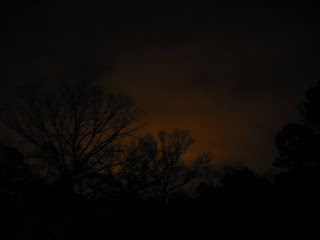

The orange glow seen from a few miles away February 11, 2013. ©

The Moon and an orange cloud (and a light) seen from a CVS on Highway 55. ©
The Moon and an orange cloud (and a light) seen from a CVS on Highway 55, closer than the location above. ©


At UNC, the Biology Department had a small greenhouse behind Coker Hall, but it was replaced by a larger one on top of the newer Genomics building, like a lighthouse at night. The brilliant white floodlights over the sports fields along South Road are intense, and are often left on when the fields are not in use. Indoor lights are left on, despite older buildings having signs on the switches, perhaps a response to the oil crisis of the 70's (stemming from US and other “Western” imperialist backing of Israel around the 1973 Arab-Israeli War), saying to turn lights off when not in use. In at least some classrooms the lights automatically turn off towards midnight, many hours after classes usually end. In addition, large windows without screens are frequently left open, such as at Hamilton Hall, even during the winter so insects and other animals come in (and then traps are used, the subject of a future post) and the heated or cooled air goes out. Some windows and doors aren't well-sealed to begin with even in newer buildings. UNC is supposed to be reducing its carbon footprint, but I think it originally promised student groups that it would close its coal-burning co-generation plant by now.


There is the bright orange light over RTP and a less glaringly obvious bluish-white glow over Southpoint Mall and the surrounding strip malls, car dealerships, and offices. A recent study in Tucson, Arizona, which has centrally controlled LED streetlights with full cut-off shielding (preventing light from going upward), found that less than 20% of the light measured from orbit was from streetlights (see a brief article in the March 2021 issue of Sky and Telescope magazine). Sometimes sweeping beams of light can be seen when it is clear, but they might not be permanent features. The fact that cloudy skies are so bright (called sky glow) is probably another example of light pollution, in this case non-point pollution coming from thousands of small to large sources. Next time snow or ice causes widespread power outages, consider how bright it is at night. Why does the landscape look so well-lit, when no sources of light are visible? Our eyes do slowly adapt to the dark, but it still seems much brighter than it should be when lights are off over a large area and the Moon and stars are hidden. I notice this most when there is snow, but it might also apply after a hurricane. There is ground level light pollution include glare and visual clutter from sources such as area lights (UNC is full of examples, as are gas stations) and LED signs (such as at the corner of 54 and Blue Ridge Road at the State Fairgrounds and one near the corner of Highway 54 and Barbee Road in Durham, which replaced a plain sign removed during the construction of Pulte's neighboring 54 Station, but it might be less noticeable now with the new LED streetlights; see the linked post), and light trespass into yards and windows. Excessive outdoor lighting or light profligacy could make people more rather than less vulnerable to crime and wastes electricity.


Light pollution from human activity in space is a new problem. Currently there is a lot of concern about the launch of many new communications satellites, eventually to number in the tens of thousands, by US SpaceX, British OneWeb, and possibly by Amazon and others, to provide high-speed broadband Internet access in places not served by terrestrial infrastructure. These relatively small satellites, currently being launched, are going into low-Earth orbit and therefore more visible than much larger communication satellites in higher geosynchronous orbits, though possibly the new satellites are not very noticeable in urban and suburban skies. The number of satellites and their ability to autonomously maneuver makes it difficult for astronomers to avoid imaging them with telescopes. The satellites can be made darker and it is possible to reduce the impact on radio telescopes, but these measures are up to the companies and might not solve the problems. A US law banning “obtrusive space advertising” is the only regulation covering light pollution from space, according to an article in Sky and Telescope magazine (March 2020). There is a higher risk of collision and malfunctions with so many new satellites, leading to more space debris, which is an increasing problem, because even tiny objects traveling around the Earth at tremendous speeds can disable satellites and threaten astronauts. Recently the crew of the International Space Station had to prepare to flee as a piece of space debris approached and satellites have collided (Wikipedia says the first high-speed collision was February 10, 2009, destroying an active Iridium communications satellite, a leftover from a similar project to provide connectivity from low Earth orbit).


SpaceX has claimed that its space-based Internet service will pay for a corporate human mission to Mars. An article in the November 2020 issue of Air and Space/Smithsonian magazine ( www.airspacemag.com/ ) discusses speculation that rather than just connecting the billions of people worldwide who lack Internet access SpaceX will instead serve the US military and that this is an area of US soft power competition with China (specifically with the Huawei company). According to Wikipedia the SpaceX project is already receiving Federal subsidies to provide domestic civilian Internet access in rural areas and has been successfully tested with US weapon systems. The British government invested in OneWeb for its own soft power projection. On the other hand, previous attempts to provide Internet access from space have failed, so these new satellite megaconstellation projects might not be completed.


For more information, see an article in the March 2020 issue of Sky and Telescope magazine ( skyandtelescope.org/ ), covering the problems posed for optical and radio astronomy. There have also been shorter updates and a related article on observing geosynchronous satellites in the October 2020 issue. The article in Air and Space focuses on the business aspect, with little mention of pollution.


A few decades ago there were ambitious proposals to generate solar power in space and manufacture in orbit, potentially reducing pollution on the ground and solving some of the drawbacks of using solar energy on a large scale. On the other hand I think the 1972 book Limits to Growth by the Club of Rome projected that collapse would come even with access to extra resources from space. Perhaps this could be called offshoring industry to space, instead of where it actually went. In the 90's Russia experimented with reflecting sunlight from space to light up cropland at night. Several years ago orbiting solar powerstations was discussed in the Raleigh News and Observer and one letter to the editor talked about probably nonsensical 'death rays' from space. In the original proposal energy would have been beamed to collector stations on Earth as apparently weak and mostly harmless microwaves, similar to radio waves.


Light pollution can have an impact on the plants. Day length controls the seasonal life cycles of many plants, and influences leaf form and root growth. Plants judge day length by sensing red wavelengths, at intensities much less than that required for photosynthesis, or for reading a book, and a short period with light is enough to confuse them. Various plants respond to day length differently, for example many houseplants ignore daylength, because daylength does not vary much over the year in their native tropical habitat, but confusion caused by indoor lighting makes it difficult to grow some vegetables and flowers that come from higher lattitudes indoors. Plants outdoors exposed to artificial light could grow in the fall instead of preparing to go dormant, especially vigorously growing plants or branches, and plants exposed to constant light more readily suffer damage from air pollution or drought. Trees can be seen producing new leaves in the fall after a severe drought, though it is unclear to what extent this is due to light pollution. I have seen tuliptree branches surrounding a streetlight still with foliage in December, while red maples and Japanese maples not so close lights produced new leaves in fall following severe droughts, such as in 2019. There are nearby silver maples that often retain some foliage into winter, though silver maples generally seem to lose their leaves early, but again it is not clear how much this is due to streetlights not far from the trees. Occasionally trees try to grow in the winter for other reasons, such as after severe injury and/or drought, and some deciduous species are somewhat evergreen when young.


This young tuliptree next to a streetlight in Durham still had a lot of green foliage December 11, 2016. ©

Different species have different light sensitivities. According to a forestry bulletin from Purdue University trees such as boxelders (a species of maple), many birches, hornbeams, dogwoods, American beech, tuliptrees, sycamores, cottonwoods, black locusts, hemlocks, and American and Siberian elms are among the most sensitive trees. High-pressure sodium lights most impact plants, along with incandescent bulbs, unless they are low intensity. Purdue recommends mercury vapor, metal halide, and fluorescent lights, in order of increasing risk. Unfortunately these blue-rich lights are very attractive for insects.


Many insects are attracted to light, especially blue light, though not all insects or moths are attracted to light. Low-pressure sodium attracts few insects, but instead it can cause insects to rest as if it were daytime. Once insects or other animals are drawn to lights, they waste energy needed for survival and are more exposed to predation. Treefrogs often hunt around porchlights and spiders spin their webs nearby, while bats circle around streetlights. Some moths can hear bats and avoid them, but mercury vapor lights somehow interfere with this defense.


A light left on overnight at the entrance to Jordan Lake State Recreation Area's Seaforth day-use area attracted many moths, including a rosy maple moth, dagger moths, and what seems to be an oakworm moth of some kind. ©

A large imperial moth and an unidentified underwing moth found outside a building at UNC; there was also a green June beetle. ©
A large imperial moth and an unidentified underwing moth found outside a building at UNC; there was also a green June beetle. © 

Moth wings, mostly from luna moths, discarded by predators at Falls Lake State Recreation Area; the predators were probably aided by lights. ©
Moth wings, mostly from luna moths, discarded by predators at Falls Lake State Recreation Area; the predators were probably aided by the park's lights. © 


A few years ago it was discovered that a dung beetle navigates by the Milky Way, which probably has not been possible over vast areas of the world for a long time, unless the beetles have a way to see the Galaxy that humans lack. The Milky Way seems to be an almost imperceptible glimmer in the Triangle during the summer, at best. The Milky Way is in the sky all year, but if I have seen it at all, it is only when the Summer Triangle asterism, which includes a segment of the Milky Way, is high on summer nights, and our galaxy might be visible as a barely brighter strip of sky. Reportedly after an earthquake knocked out the power in Los Angeles people were frightened when they looked up and saw the arc of the Milky Way, though it was a familiar milky-looking glimmer in the night sky throughout the existence of humanity, until several decades ago.


The media airs satellite images showing the mostly dark, heavily sanctioned DPR Korea contrasting with the brilliant glow radiating out of the ROK and northeastern China, but while capitalist East Asian cities are spectacles to see (apparently Hong Kong has been called the most light polluted city on Earth), all that light represents wasted energy, probably generated by burning fossil fuels or dams, and climate change is becoming more and more obvious around the world and could ultimately burn us all.


Predators can benefit from artificial lighting, but this upsets the ecological balance. In Switzerland when streetlights were installed in some valleys, a bat that did not hunt at streetlights went locally extinct while a similar species that could make use of the lights made inroads, though light was probably not the only factor. Large toads enter streets to hunt under neighborhood streetlights on summer nights here, where they frequently get run over. Apparently amphibian eyes can take hours to recover after exposure to bright light, so they may be left blinded by passing cars. It is probably well-known that coastal light pollution confuses endangered sea turtle hatchlings, as well as disrupting the vertical migrations of zooplankton, tinkering with the base of the marine food chain. Commercial fishing actually introduces a lot of light pollution far out in the ocean in some places, visible from space. Many aquatic animals are attracted to light at night and marine organisms use light to lure prey or startle predators.


Birds migrating at night, especially in storms, are attracted to lights and crash to the ground after collisions or exhaustion. Thousands of birds can die at once when flocks of waterfowl mistake parking lots for water and try to land as if on water. The Fatal Light Awareness Program (www.flap.org) estimated that one to ten birds die per building per year, due to collisions with glass or light pollution, and 100 million to one billion migrating birds die each year in North America (this might refer only to the USA and Canada). People sometimes complain about depredations by cats, but might be ignoring losses due to buildings, windows, habitat loss, insecticides, climate change, airplanes, and the increasingly powerful wind energy lobby. If birds and other wildlife are killed by proposed wind turbines beyond the horizon off the Outer Banks, how will we know? It also seems like marine life would be disturbed by offshore construction, as it would be by oil exploration. Like a full Moon, artificial light prompts birds like mockingbirds to sing at night, with unknown impacts (see the link to an upcoming webinar on new research below). Mammals generally avoid lit-up areas, so lights could drive them away from habitats they could otherwise inhabit (this might include bobcats, which are still sometimes seen in the Triangle).


There have been few studies of light pollution's affects on us, but artificial light at night may cause cancer and could damage eyesight and is supposed to contribute to sleep problems. Working at night is supposed to increase the risk of various diseases. There are conflicting studies regarding crime, but criminal activity is more visible with motion sensitive lighting than continuous lighting. It would not be surprising if all the glare at UNC increases crime and it detracts from the beauty of the campus.


The night sky is a commons everyone had access to just by looking up, until air pollution and light pollution became abundant, another example of business dumping its externalities and abusing or expropriating the commons for private use, though in the case of light pollution we also do it to ourselves on a smaller scale. The starlit sky was important in human development, though things are much more abstract now, so religious ritual is conducted indoors, abstracted and estranged from our natural environment; astronomers don't have to observe at night; and the heavens are now a destination for tourism, neoliberalism, and warfare. Despoiling a lifeless celestial body like the Moon might not be the same as despoiling the Earth's living biosphere, but damage to the environment, our common cultural heritage, and Space Age historic sites on other worlds is still likely. US space policy under Trump, Obama, Bush, etc. seeks a cosmos under neoliberalism and imperialism. At state parks in rural eastern North Carolina, such as Jones Lake, there is little light pollution and the sky is so full of stars that it can be hard to recognize the constellations, but these are still not primordially dark skies. Amateur astronomy groups from the Triangle have to travel to places such as Medoc Mountain State Park to find relatively dark skies. Jordan Lake has darker skies than Durham, but the Milky Way is still obscured.


Fortunately there are low-hanging fruit on the path to restoring the night sky. Lights should be shielded so they only shine downward and turned off or dimmed when not in use, though a large percent of light still reflects off the ground and into the sky, such as at the vast and empty after hours parking lots around Southpoint Mall and neighboring strip malls. Outdoor lights should be checked regularly to make sure they stay correctly aimed. It is helpful to organize residential outdoor lights in separately controlled zones. Designers recommend beginning with less illumination than you think you need, to avoiding putting in too much. If a transformer is necessary, factor in how many lights you might connect to it when deciding on wattage. Lights might be placed around pools for safety, but fish are not immune to light pollution and can sense electromagnetic fields. Use high-quality fittings, especially for more exposed low-voltage systems. The International Dark Sky Association ( www.darksky.org ) has recommendations on design and specific fixtures.


Exterior lights require much less intense wattage than interior lights, and soft lighting usually looks best. Low pressure sodium bulbs minimize light pollution, but they produce monochromatic yellow light. An increasing problem is blue-rich white light (BRWL), produced by otherwise environmentally-friendly LEDs. Our eyes are especially sensitive to blue light, so we perceive more intense pollution from them (consider how blinding oncoming blueish-white car headlights are), though this light transmits a shorter distance through the air than redder light. BRWL lengthens the time necessary for our eyes to adapt to darkness and is less visible to the elderly. Warm white LEDs (less than 3000K) are a better choice.


At the start of the pandemic last spring the City of Durham was still able to send teams to install about 21,000 LED bulbs, apparently energy-efficient but producing glaring, probably blue-rich, white light, on existing and new streetlights, and the number of streetlights alone (mandated by the UDO in new construction) was already a problem in some neighborhoods. These LED bulbs could be the reason why it seemed like more cicadas than usual were being attracted into the street at night and often killed last summer.  Recently I noticed that the new traffic circle at the intersection of Herndon and Barbee roads seemed to be tinged blue or even violet, though the effect might have been heightened by yellower lights leading up to the intersection.  


Durham's streetlights might have become more energy efficient over the decades, but it has also gotten ever harder to see the stars without traveling some distance, and then there is the chance that people will be suspicious or even call the police. Neighborhood parkland where I watched meteor showers and saw the bright comets Hale-Bopp and/or Hyakutake has since been marred with a streetlight, though the area is supposed to be closed at night. I have suggested, without result, to the representatives of “developers” and officials that they could create dedicated places for people to stargaze, such as where there are ridges or lakes offering good views of the entire sky. Some public lands in the Triangle are open 24 hours a day, but they are often somewhat distant and there still might be dangers in going there to see the night sky.


Reportedly people can request extra shielding on treetlights in the City of Durham by contacting transportation specialists Terry Thompson or Denise Warren at 919 560 4366 ext 36407 or terry period thompson at durhamnc period gov or denise period warren at durhamnc period gov durham and they will send the request on to Duke Energy. People can request the removal of offensive streetlights, but the Durham Police Department gets a veto.


A few years ago Trump brought up some of the obvious problems with new forms of lighting, but advocated going backwards to inefficient, and therefore polluting, incandescent bulbs instead of looking for new ways to combine efficiency and aesthetics. Red light is supposed to be less harmful to human nocturnal vision. Perhaps lights could be designed to be less visible to wildlife, smart enough to activate only when needed, and more efficient.


Virtual LUNCHBOX Talk: Analyzing the Effects of Urban Noise and Light Pollution on Avian Communities


NCSU Master of Science student Lauren Pharr will talk about the impact of anthropogenic noise and light pollution on area birds in a webinar February 25th 12 – 1pm, organized by the NC Botanical Garden and the New Hope Audubon Society. The Botanical Garden offers a Lunchbox Talk on conservation topics every month. For more information and registration see: ncbg.unc.edu/learn/


Proposed rezonings in southern Durham County and the City of Durham


Also related to the post linked at the beginning, there was a community consultation meeting via Zoom Tuesday, January 26th 6 – 8pm about the hundreds of acres owned by the Triangle Brick Company west and south of the intersection of Highway 55 and Hopson Road. “Development” interests, typically represented by lawyers and/or engineers at these legally mandated meetings, want to have this vast area (I think the figure was 241 acres and it is probably roughly a mile or even more from east to west) around the abandoned claypit, extending from both sides of 55 to within view of Grandale Road on a ridge, much of it already clearcut several years ago, rezoned to be all Light Industrial (some of it is currently Rural Residential) and annexed by the City. The proposal is a business park, ultimately with 5 to 6 short office or industrial buildings, similar to those at the corner of Hopson and 54, with staged construction beginning in the spring of 2022. Of course if a site is rezoned without a development plan, something else could be built, if consistent with the zoning. Another large chuck of land west of this “assemblage” was clearcut a few years ago, and it seems like it is only a matter of time before it will be sold and built on. These are some of the last large tracts of undeveloped, rural private land surrounding the Wildlife Resources-managed gamelands around Jordan Lake at the very south end of Durham County. This Federal land as well as some owned by Durham County covers bottomland that can be inundated when the Lake is used for flood control, and doesn't protect much of the higher ground. Some species need both lowland and upland habitats, such as many salamanders, and others might live in bottomlands only because the uplands have been made inhospitable for them by sprawl. Not far south of the countyline there have been vast changes as residential sprawl around rapidly growing Cary in Wake County spread into northeastern Chatham County, formerly remarkably 'empty,' except for a few houses and older subdivisions (maybe these would be called exurbs), with vast expanses of relatively young forest, some of it held as private hunting reserves, inhabited by flocks of turkeys, possibly bobcats, etc. Rarely seen bobcats might be one of the mammals that can be driven away by artificial lighting. Today the area is almost unrecognizable, with old roads renamed or rerouted, two lane roads have become wide enough for many lanes, and much of the forest and old houses were scraped away, creating a lunar or martian landscape during construction. For years there have been yard signs nearby saying 'no' to Cary.


Looking roughly southeast from the powerline at the northwest corner of the site in 2012; this is only part of the "assemblage" and is now a young pine forest. ©


The intersection of Hopson Road and NC 55 at the east end of the site, which includes the wooded land in the background and some to the left. ©
The intersection of Hopson Road and NC 55 at the east end of the site, which includes the wooded land in the background and some on this side of 55, to the left. ©


Looking east from the northwest corner in 2018; most of the land on the left is owned by the US government and Durham County; NC 55 is out of sight behind a ridge far down the powerline and the old claypit is behind the forest in the center. ©

Looking east from the northwest corner in 2018; most of the land on the left is owned by the US government and Durham County; NC 55 is out of sight behind a ridge far down the powerline and the old claypit is behind the forest in the center. ©


There will be a meeting Thursday, February 18th 6-8pm about the 40 acres of Durham County-owned land at 451 TW Alexander, 6001 NC 55, and 6026 Experiment Drive/Avenue. This is where a large hill was blasted away several years ago for a failed commercial or residential project, the earth being used as fill for North Carolina's first toll road, part of the ring of 540 around Raleigh (construction which could harm the endangered dwarf wedgemussel in southern Wake County). Apparently excess material from the hill was dumped in the claypit. Nearby roads were re-routed and a new road built, near the colony of pinxterflower azaleas, as well as deep red, five-petalled fire pinks and other common to very rare wildflowers around a former farm. The area is probably unusual because of the presence of igneous rock formations, unlike the typical sedimentary bedrock in the Triassic Basin of southern Durham. I last heard that the County wanted to build something like a sludge-drying facility for the nearby Triangle Wastewater Treatment Plant, but the neighborhood meeting is about rezoning to Office and Industrial (parts of the site are currently zoned for residential, commercial, and office use) for “a new Durham County Public Works Administration Building.”


The site in 2010; there was a wooded hill with a house here and this is about where the driveway was; the Triangle WWTP is lower out of view on the left and there is now a residential development on the right, across TW Alexander Drive. © 


Community consultation meeting information and other planning-related announcements are sent out every Friday through the Planning Public Notification Service of the Durham City-County Planning Department ( sign up at durhamnc.gov/411/Planning-Public-Notification-Service ). Those owning land within a certain distance of a proposed rezoning receive legally mandated notifications by mail. There is a link to join the meeting via computer or phone, but it is not working:  dtwarchitectsandplanners.my.webex.com/dtwarchitectsandplanners.my/j.php?MTID=m687db88b818ca d7daefa13e28c13a1bf  To join by phone, call 415-655-0001, meeting ID 142 953 5347.


There will be meeting 5 – 7pm February 18th about rezoning 2102 So Hi Drive from Rural Residential to Science Research Park, to build two office buildings. This is a large piece of land at the corner of So Hi and Northeast Creek Parkway, bordering RTP. The site is on the south (RTP) side of the intersection, extending from the Triangle Curling Club on the east to about an equal distance west, on Northeast Creek Parkway. The owning entity is Parmer Woodlands 3 LLC, with an address in Carlsbad, California, and similarly named companies with the same address own large parcels adjoining 2102 So Hi and on the west side of the intersection, making up most of the north end of RTP. Northeast Creek flows through 2102 So Hi, and is joined by a small stream flowing from the north that crosses So Hi in a narrow valley by a church. Beavers have been very active in the area and this might be where there is or was a very large, though shallow, beaver pond, between a ubiquitous sewer easement and a high-tension powerline. Fish probably include pickerel and bowfin and would be hunted by belted kingfishers. Other ponds can be seen from Northeast Creek Parkway. Durham's Interactive Maps ( durhamnc.gov/1455/Interactive-Maps) shows a large body of water there, though maps are often inaccurate regarding waterways. Fire pinks, pinxterflower wild azaleas, evergreen Catawba rhododendrons, more than one species of dogwood, umbrellatrees (a deciduous magnolia, blooming around May 1st here; fire pinks might also bloom in May, while pinxterflowers bloom in April), spicebushes, milkweed, burdocks, Hepatica, star chickweed, toothworts, liverworts, and horsetails are some locally uncommon to rare plants growing in the general area. Nearby areas are carpeted with spring ephemerals and some, such as lavender Hepaticas, could be blooming already and can start around January if it is a 'warm' winter. Hawks are common, phoebes nest along the Creek, and upstream hummingbirds fight over summer beds of orange jewelweed. The usual procedure is for the rezoning or annexation applicant to have one or more informal community meetings, followed by a formal hearing before the Planning Commission, and then a hearing during a regular City Council or Board of County Commissioners meeting.


To join via Zoom, go to zoom.us/join, meeting ID 884 8173 7483, passcode 450403, or call 646-558-8656 and enter the same ID and passcode.


Looking north on Northeast Creek Parkway; Northeast Creek parallels the road on the right. ©

Looking north on Northeast Creek Parkway; Northeast Creek parallels the road on the right. ©


A Hepatica off of Grandale Road in late March. ©

Hepatica with fresh new leaves, trout lilies, spring beauties, Christmas ferns, and probably some star chickweeds in early April off of So Hi Drive. ©


Third party ballot access in North Carolina after 2020


The NC Green Party lost its hard won ballot access with the 2020 general election, with campaigning and petitioning hobbled by the pandemic. Without ballot access Greens running for office will have to get on the ballot individually or run as write-in candidates and will not be listed as Greens and voters will not be able to register as Greens. The NCGP is asking Governor Roy Cooper to maintain the Party's official status and/or to maintain the status of registered Green voters for 18 months; waive petition requirements for all parties that had ballot access as of 2020 (the Constitution Party apparently also lost its ballot access last year); and to lower the required number of signatures to establish or re-establish a party by at least 75% and to allow electronic signatures. The pandemic severely limited campaigning last year and makes petitioning hazardous, and there aren't gatherings where people could be asked to sign in-person. Greens plan to run in several local elections in 2021. For more information, a sample letter, and to sign up to send a letter or email, go to: www.ncgreenparty.org/ask_cooper_for_covid_relief


RDU Quarry Town Hall with NC Senator Wiley Nickel


There will be a town hall meeting about the proposed rock quarry at the RDU Airport, adjacent to Umstead State Park, Wednesday, February 10th 6 – 8pm with Wiley Nickel of the NC Senate and Dr Jean Spooner of the Umstead Coalition ( umsteadcoalition.org , www.facebook.com/umsteadcoalition/ . To sign up and submit questions see:  forms.gle/78F8oVdBE7e9hrKy6

Monday, December 31, 2018

Burdens Creek Bluff and surrounding landscape, trashed


Looking down into the floodplain in late March. The buckeyes are leafing out and the trout lilies are about done blooming ©.
About a mile north of the pinxterflower azaleas threatened by Duke Energy there is another area with unusually diverse and abundant wildflowers for this part of the Triangle, but marred by rampant trash dumping and there are other problems nearby (for the pinxterflower article, posted September 8th, see: durhamspark.blogspot.com/2018/09/pinxterflowers-duke-energy-and-federal.html ). From the pinxterflowers, we go north along the edge of RTP, crossing TW Alexander Drive at the light, quickly coming to the top of a hill, stopping before the bridge over Burdens Creek. On the east a relatively young forest, hiding some brickwork and a former farm pond (visited by the occasional great blue heron and bordered by buttonbushes, a very good flower for butterflies and other pollinators, if I remember correctly), was levelled and the pond filled in around 2009 to build what is now a Duke Health office building surrounded by a large treeless parking lot (where the pond was). I think the builder was required to build a mulched trail along the sewer easement paralleling Burdens Creek, but floods washed it away and it was never replaced. As I started writing this article the site was owned by Phoenix, Arizona-based Cole Real Estate Investments, but maybe two weeks later the name changed to Cole HC Durham NC LLC and the mail is directed to The RMR Group in Newton, Massachusetts (see Durham's interactive GIS maps at durhamnc.gov/1455/Interactive-Maps ). There are a lot of wildflowers in the surrounding woods, though English ivy, multiflora roses, and other non-native plants grow in the swampy woods north of the parking lot and the population of native Indian grass on a utility easement along Alston seems to have been destroyed by utility or road work. South of this site there is a brick building long housing an American Legion post, now apparently used as a church. Some native and introduced flowers grow along Alston, and old-fashioned pink and dark red roses bloom (or once bloomed) in May at a secluded spot closer to the Social Security Administration facility. To clarify some details in the earlier article, property records say that the SSA's building was built around 2008 on land last sold May 1, 2007 and is owned by Winston-Salem-based JDL-RTP LLC.


Swampy forest left between Burdens Creek and the Duke Health building, visible on the right. Amphibians breed in these seasonal pools and there are many wildflowers, but this young forest also has more non-native plants than the forest on the west side of Alston, for example the Japanese honeysuckle visible here ©.

On the west side of Alston there were a few small houses, but today only one is left, overlooking the bridge at Burdens Creek. At the crest of the hill a house surrounded by woods was used as a daycare for a long time, but was replaced by a complex with three brick buildings (5310 South Alston Avenue) in about 2002. It apparently won a 2003 Merit Award in the North Carolina Architectural Competition, sponsored by the Brick Association of NC (but I can only find one reference: www.loopnet.com/Listing/14218503/5310-South-Alston-Avenue-Building-100-Durham-NC/ ; other photos at: www.loopnet.com/Listing/19797681/5310-S-Alston-Avenue-Durham-NC/ ). I think I read once that the office complex was designed by Durham's Freelon Group, Inc., and it houses their office, merged with Perkins+Will in 2014. The complex had been listed as belonging to The Dilweg Companies, LLC ( www.dilweg.com/ ), with offices in North Carolina, Tennessee, Georgia, and Florida, and a focus on office buildings, but in recent years the owner has been listed as I-LOFT RTP LLC, based in Suite 210, the same address as Dilweg's Corporate Office. I was thrown out of this complex once, which I attribute to white collar bias. Parts of the complex are listed as belonging to the Life Community Church of RTP NC INC (with an RTP address; I haven't seen any activity at building 100, on the south end, but it is apparently Life International's Global Leaders Center). John S Carbone LLC (in nearby Morrisville) and CCR Durham Land Holdings (in Santa Monica, California) are also listed as owners, and other companies lease office space. There are few wildflowers in the remaining young, piney woods surrounding the complex, but the property lines extend down the slope behind the buildings and across the floodplain where there is older deciduous forest with more floral diversity.
 
There is a lot of privately-owned open space in Durham, even in the urban core, often owned by companies far from North Carolina. In urban areas there is the similar issue of public spaces that are increasingly privately-owned, so people can be deprived of rights more easily than in truly public city squares and parks. There is also the issue that volunteers can freely pick up trash in a park, but could be barred by private owners, even if the owners refuse to take responsibility themselves. There are a few more or less working farms in Durham (and more in nearby Orange County), but the non-built up parts of Durham are mostly long abandoned farmland now returned to forest, probably because farming so close to an urban center became cost prohibitive. Over the decades a lot of “development” in Durham has been on this former farmland at the periphery. Durham had two malls, to which was added Southpoint Mall at the south end of the County, so Durham briefly had three malls, and at least two more close by in neighboring counties, but then older South Square Mall closed and that site still hasn't been completely re-developed, so Durham is back to having only two malls. Supposedly sprawl wasn't going to spread from Southpoint, but that is what seems to be happening, even before the General Assembly forced Durham to accept 751 South few years ago. It has only been relatively recently, maybe in the last 10 to 20 years, that there has been much building downtown, in the abandoned ruins of the tobacco industry and open spaces.
        
The main concern is next to the offices, at the Falls Pointe at the Park Apartments (100 Cascade Falls Lane, www.fallspointeattheparkapartments.com/ , formerly fallspointeapartments.com/ ). I thought they were built after the office complex, but property records say Falls Pointe was built around 2001. For several years if not from the beginning Falls Pointe belonged to The NRP Group, LLC ( www.nrpgroup.com/ ), based in Cleveland, Ohio and having 16 offices, all in the East, including one office in NC (4515 Falls of Neuse Road Suite 100 Raleigh, NC 27609). According to property records, the complex was sold (by subsidiaries NRP Alston Village, LLC and NRP Alston Management, LLC) April 25, 2018 to Fairfield Residential ( http://www.fairfieldresidential.com/ ), based in San Diego, California (5510 Morehouse Drive Suite 200 San Diego, California 92121), although the actual owner is a subsidiary called Fairfield Falls Pointe LLC, with the same San Diego address. NRP still owns a large area of floodplain that surely cannot be built on, perhaps as mitigation for construction elsewhere (last sold December 27, 2000, presumably the date when they originally acquired the land). This article mainly covers the period under NRP management, and it is possible things will improve, but there was still plenty of trash in the woods in the fall. Before the apartments were built there were about two small houses near the road, with a large field of tawny broomsedge and lawn in between, and young lobolly pines, red cedars, and maybe a thicket of sumac or blackberries towards the back, but this mostly flat area drops off steeply to the edge of the swampy floodplain west and northwest, forming what can be called Burdens Creek Bluff. Older deciduous hardwoods grow on the slope and in the floodplain. A slough, probably a former course of Burdens Creek, runs along the base of the Bluff, which slopes more or less steeply down from the apartments, with some natural terraces.
 
Behind Falls Pointe the hillside has a lot of plant diversity, and is literally covered with flowers in early spring, probably because of atypical soil weathered from igneous rocks that intruded into the surrounding sedimentary rocks millions of years ago; the long time the forest was left mostly undisturbed; and the cool, moist microclimate formed by the steep, generally northwest-facing hillside. Some flowers can bloom as early as December, but definitely by March yellow trout lilies densely cover the slope, especially at the top, while lower down there are numerous grasslike spring beauties with white flowers that open when it is sunny. Relatively rare toothworts, another white to pinkish flower, are common on a moist terrace and there are rare pennyworts. Other spring flowers include rue anemone (also known as windflower, a forb with white flowers that nod in the wind), purple-colored violets, saxifrage, and possibly relatively rare white star chickweed, related to the rare firepinks once found down the road. The blue or lavender to white flowers of Hepatica, formed by sepals rather than petals, can appear as early as December or January. Hepatica and evergreen wild ginger have leathery leaves with interesting marbled patterns as if for camouflage. Trout lilies also have striking leaves, finely dappled like the sides of a native brook trout, only visible in spring. Trout lilies are also known as dogtooth violets, but are lilies. Many of these native wildflowers are relatively rare in the Triangle and are very abundant here. Being flowers of older woodlands and early blooming (several are spring ephemerals, perennials that only appear aboveground for a short time, before the trees leaf out), they are probably unknown to most people today.
 
Five hundred years ago these flowers and species now entirely absent might have grown all over what is now Durham, but agriculture and overharvesting are probably the reasons they are now restricted to older woodlands near waterways. Overgrazing by deer might be another factor, and the scarcity of predators (due to human persecution and habitat loss, but some remain) or areas where deer can be hunted allowed their population to boom. Catesby's trilliums, if not other species of trillium, are supposed to grow in the Triangle, but I have never seen any, except for a dark red species growing along woodland trails at the NC Botanical Garden, presumably planted. Further west, Randolph County must be full of them, if they can allow acres of trilliums to be drowned under recently impounded Lake Randelman, on the Deep River south of Greensboro and north of the town of Randleman ( ptrwa.org/index.htm ), from what I have heard.
 
Trout lilies and some spring beauty leaves in late February ©.
 
A few toothworts and spring beauties still blooming in late March and there are many trout lilies not blooming and a sprig of strawberry bush ©.


Spring beauties in bloom and trout lily foliage ©.


Toothwort, rue anemone, and spring beauty flowers ©.

The forest floor in April is carpeted with blooming spring beauties along with many other wildflowers, not blooming, such as pink wood sorrel ©.

Later in the spring pink wood sorrel, mayapples, alumroot, and Solomon's seal (or a relative) bloom, while at the foot of the hill there seem to be Atamasco or Easter lilies. I have heard that these large white lilies used to be abundant at what is now the Greenwood Commons shopping center nearby. There is a huge patch of dwarf crested irises, though they might be too shaded to flower. There could be some Carolina blue bluets around, a relatively common spring flower, though I haven't noticed many in recent years. Cranefly orchids have leaves that are dark green on top and bright purple below during the cool months, but are leafless by the time they flower in summer. Beechdrops also bloom in summer and are always leafless, being parasitic on beech tree roots. There are jack-in-the-pulpits in the bottomlands. Spring is the best time for flowers at the Bluff, but some composites bloom in the summer and fall when there is mostly heavy shade.

Dark evergreen Christmas ferns grow near the foot of the hill, and there are a few other ferns. Large igneous boulders at the top of the slope are covered with clinging resurrection ferns, so-called because their thick leaves can shrivel up, but resurrect green and flat again later. There are also a few spleenworts amid the rocks and even growing out of small cracks. There is little if any poison ivy on the hillside. In May bright red coral honeysuckle blooms along the forest edge behind the apartments, as do very large strawberry or hearts a'bustin (with love) bushes, named for their spiny, hot pink capsules that dangle red-orange seeds in the fall; their flowers are much less spectacular. The shrub layer also includes lots of painted buckeyes that have yellow flowers in March, visited by bumblebees; maple-leaf viburnums that have clusters of white flowers in May; and pawpaws, possibly the dwarf variety. Taller pawpaw groves are common along nearby creeks and have large, cloying, bananalike fruit in late summer. The hillside has a few scattered dogwoods, redbuds, and fringetrees that bloom in March and April when they get enough light down in the understory. Overhead there are various oaks, hickories, American beech, ash, sugar maples, and a large black walnut, surrounded by legumes during the summer.


Resurrection ferns, cranefly orchids, trout lilies, coral honeysuckle, and other plants at the top of the Bluff ©.
Frogs and probably also salamanders breed in the pools below the Bluff in early spring. Marbled salamanders and small snakes shelter under debris on the moist hillside. Eastern newts, seemingly rare in this part of Durham, have been found in the neighborhood, and much more common Eastern box turtles can also be found. By late summer large brown mosquitoes make going into the forest problematic, but there are also many fireflies and large black damselflies, the territorial males jet black with bodies that flash with blue and green iridescence in the forest shade. In the large area of bottomland forest barred owls, hawks, migratory yellow-bellied sapsuckers, herons, and other birds can be heard or seen at various times. There could be wood ducks, pileated woodpeckers, prothonotary warblers, woodcocks, and even turkeys. River otters are said to live in relatively small and clear (except when it turned opaque and yellow as 540 was being built upstream) Burdens Creek. There are many crayfish and fish in the Creek, and probably freshwater mussels, though the main species might be an Asian species. There are also beavers. Once in these woods I suddenly found myself walking along next to a possum during the day and there are raccoons and deer. With the people there are also feral or pet cats. Maybe there are nocturnal flying squirrels, and there must be flocks of moths and katydids on summer nights, Urbanization must be reducing their numbers, but I see a lot on Hopson Road on summer nights.
 
Fortunately the richest and oldest woods were mostly left alone when the apartments and offices were built, but the apartments come very close to the edge of the slope, which people seem to take as an invitation to dump their trash, and NRP never seemed much troubled by it. Landscaping contractors dumped fallen leaves, uprooted bushes, excess soil, etc., though one of NRP's local managers claimed they were against this (it seems like they should have been in control of their own contractors). The large debris piles take years to decompose, so plants underneath are killed, and this debris propagates non-native bushes into the woods. People go to these piles and dump trash, or throw it just inside the forest edge or over the slope. Maybe a year or two ago one brush pile had a lot of disposable diapers and the one next to it a lot of bagged pet waste, leading to the question of which is worse, the fecal coliform bacteria and pathogens or the plastic that won't decompose or fragment for a very long time. At various times there have been small piles of kitchen garbage, mattresses, furniture, a sofa, a broken wall mirror, rugs, tools, cellphones, a wrecked laptop, a computer monitor, batteries, plastic food packaging, plastic and glass bottles, cans, pots, shoes, etc. The complex has a central trash compactor and recycling center and they must have rules about trash disposal. NRP's local management claimed they cleaned up trash something like once or twice a year, probably meaning at most only a few feet into the trees, even though NRP owned and still owns a large area of the forest. The only reason there isn't more trash there now is because volunteers clean up some of it, mainly the plastic, one to three times a year. A few years ago Durham County passed a law forcing people to clean up excessive trash or aesthetic 'problems' on their land, and that helped here three years ago. The law is probably aimed more at penalizing homeowners, who may be poor, old, or prefer unconventional or naturalistic, wildlife-friendly landscaping, rather than companies that don't care about trash as long as it isn't in front of their offices. Besides the trash, herbicide is or was periodically sprayed along the forest edge and chemicals are probably spread on the lawns. Native solitary bees, providers of valuable and free pollination services, dug their burrows in one spot. Some stormwater is sent over the hillside, causing erosion, though I have seen worse though probably legal examples, such as behind the Phillips Research Park Apartments, located on a hill off Ellis Road at the north end of RTP, also surrounded by biologically rich older woodland, and at the Old Chatham Golf Club in Chatham County, though that might have been corrected by now.


Some of this is snow, but most of it is trash thrown behind Falls Pointe in winter 2010 ©.
  

A few volunteers picked up some trash that spring (photo) and in the fall ©.


Trash picked up in spring 2015 (there were other cleanups through 2018 not shown) ©.

Here is a pile of yard waste and trash that same spring ©.
Three mattresses thrown in a brush pile, a sofa, a burned bicycle, etc. dragged out of the woods in fall 2015 ©.


A pile of trash in summer 2017 ©.

Having corporate offices far away, selling frequently, and creating subsidiaries helps those in control avoid accountability while generating capital. The land, created by nature over an eternity, is seen as a commodity, something created only for exchange on a market, rather than for its use-value, as the common environment humanity and the rest of nature inhabits. I did a short search to see what Marx said regarding the natural environment, and, among other works, there is a chapter of The Economic and Philosophic Manuscripts of 1844 (International Publishers, 1964, reprinted 1984, page 101 – 102; another translation is posted online at: www.marxists.org/archive/marx/works/1844/manuscripts/rent.htm ), containing some of his early writing. This passage is mainly about land used for agriculture and the transition from feudal landed property to capitalist commodification of the land, as is common around the world today, and especially in the USA, created out of colonies with few or no leftover feudal relations, after the land had been basically seized from its native inhabitants, who also had few or no feudal relations. Marx writes without sentimentality about the transition from feudalism to capitalism, which can then be replaced by socialism: “It is necessary that this appearance be abolished [“the semblance of a more intimate connection between the proprietor and the land than that of mere material wealth” and the “political” and “human, intimate” connection between the proprietor and his serfs] … ”that all personal relationship between the proprietor and his property cease, property becoming merely objective, material wealth; that the marriage of convenience should take the place of the marriage of honor with the land; and that land should likewise sink to the status of a commercial value, like man. It is essential that that which is the root of landed property – filthy self-interest – make its appearance, too, in its cynical form. It is essential that the immovable monopoly turn into the mobile and restless monopoly, into competition; and that the idle enjoyment of other peoples' blood and toil turn into a bustling commerce in the same commodity ... The medieval proverb nulle terre sans seigneur [there is no land without its lord] is thereby replaced by that other proverb, l'argent n'a pas de maître [money knows no no master], wherein is expressed the complete domination of dead matter over mankind,” domination over both the landowner and the worker. Later he writes that “Association,” replacing capitalist relations, has both economy of scale and equality, and “reestablishes, now on a rational basis, no longer mediated by serfdom, overlordship and the silly mysticism of property, the intimate ties of man with the earth, since the earth ceases to be an object of huckstering...” There is extensive discussion of the false view of land and other economic factors as commodities in The Great Transformation: The Political and Economic Origins of Our Time by economic historian Karl Polanyi, published in 1944 (quotes are from the Second Beacon Paperback, published in 2001). He writes that “A market economy must comprise all elements of industry, including labor, land, and money … But labor and land are no other than the human beings themselves of which every society consists and the natural surroundings in which it exists. To include them in the market mechanism means to subordinate the substance of society itself to the laws of the market” (page 74 – 75). But even in the early 40's it could be seen that in treating land as a commodity “Nature would be reduced to its elements, neighborhoods and landscapes defiled, rivers polluted, military safety jeopardized, the power to produce food and raw materials destroyed … no society could stand the effects of such a system of crude fictions [labor, land, and money treated as commodities] even for the shortest stretch of time unless its human and natural substance as well as its business organization was protected against the ravages of this satanic mill” (page 76 – 77).  

There would have to be much more trash to kill the wildflowers, but this special area that should be appreciated and protected is instead marred with trash, and the trash is harmful to the plants and possibly wildlife. Whatever waste isn't decomposed or buried washes into Burdens Creek and on towards Jordan Lake, where a large amount of trash is cleaned up by volunteers and government employees every year. No doubt tons of debris and trash have to be cleaned up at Jordan Lake State Recreation Area's swimming areas after the prolonged flooding in the fall. There are worse threats to local biodiversity, but the attitude that it is okay to dump trash in a woods, where few will see it, is like the attitude that it is fine to let exotic chemical GenX or pharmaceuticals get into the Cape Fear River, leave coal ash where it could contaminate groundwater and waterways, bury toxic waste near Crabtree Creek, or send excessive carbon dioxide and poisons from fossil fuels into the atmosphere. It might be out of sight and out of mind, but it adds up to become a problem for the community. Things like light pointlessly radiated into the night sky, the winter roar of traffic on I-40, and native trees engineered to suit the timber industry are also a kind of dumping and lack of consideration that could harm other people and our common environment. I hope to write about some of these problems in the New Year.

There must be other trash-filled natural areas in Durham, but I am glad to rarely come across them. At one time, possibly when suburbs first came to these parts, trash was dumped at certain bridges and the ends of roads, and volunteers cleaning up trash for Earth Day (April 22nd) and Big Sweep (early October in Durham) still find appliances, mowers, shopping carts, even cars, but much of the trash has been removed and nature is overwhelming and burying the junk. The early suburbs also dumped partially treated sewage into creeks and while the water released by treatment plants into many creeks today is far cleaner, it is still a source of pollution. Sometimes people still dump trash and yard waste on roadsides or in secluded areas, but they can get into trouble if there is a witness or something that bears their address is included. In one of the more unusual cases, pounds of seemingly edible bread were scattered along So-Hi Drive. Rural trash middens, half-buried deposits of antique glass jars, etc., sometimes even divided by brand, are hidden in woods all over Durham County. This trash is half-buried, becoming more of a 20th century archaeological curosity than an eyesore or hazard, though animals such as mice and emerging cicadas could get trapped and snakes have been known to swallow bottles and golf balls, another frequent find in wooded areas. Fresh litter is abundant in many places, escaping from dumpsters behind businesses, discarded along high-traffic roads, or washed in during floods. Every week Durham's semi-automated trash trucks release litter as they make the rounds in my neighborhood.
 
Lots of trash, probably from Durham, dumped at the Northeast Creek Waterfowl Impoundment in Chatham County (owned by the Army Corps of Engineers and operated by the NC Wildlife Resources Commission) and probably cleaned up by government workers ©.
  
Litter and bags of trash and tires dumped where Ellis Road crosses Northeast Creek in Durham ©.

Keep Durham Beautiful probably lacks the power to prevent a lot of these problems, but also doesn't help concerned citizens enough, and local and state governments also seem to care little, though they have some power to stop the dumping and get it cleaned up. It is very hard to get the NC DOT to fulfill its responsibility and pick up large junk dumped on rural roadsides, which they claim they can't find when informed, though they were very diligent in spraying herbicide along Scott King Road and Highway 54 over the summer (see the earlier post). Volunteers can adopt roads and clean up litter there two or three times a year, but not all roads can be adopted, including even some roads that have signs saying that they are available.  
 
Across the railroad tracks behind Falls Pointe there have been plans to build on hills at the northeast corner of TW Alexander and Highway 55, across from the Triangle Wastewater Treatment Plant (and a sludge drying facility will be built on the southeast corner) for several years, but clearing started a few weeks ago, before the snow, and a Charlotte-based subsidiary of the PulteGroup, Inc. ( www.pultegroupinc.com/home/default.aspx ), one of the largest residential builders in the US, bought the corner October 9, 2018. The site was last cleared several years ago, but a thick young forest resprouted. I don't think there are a lot of wildflowers there, but there might be some jack-in-the-pulpits. I thought Pulte might leave some woods between the houses and the treatment plant (though it has been upgraded several times over the years and doesn't produce as much of a smell now), but everything is being cut, except along a stream coming from the SSA site and a wetland that might have been flooded by beavers. The hill has a good view, but it would not be surprising if Pulte mass grades it down to a more mediocre level, allowing a lot of silt to erode into the stream, which goes into Burdens Creek, with few around to see it.
 
Looking south from the Pulte site, across TW Alexander Drive to the large field where a high hill once stood; the SSA facility is in the distance on the left ©.
 
Another view of the Pulte site; the saplings have mostly been cleared, but it is doubtful if any of the larger trees still standing, or even the contours of the land will still be here when they are done ©.

 
A barred owl perched in this relatively large oak, but it is just barely on the wrong side of the "Tree Protection Area" fence, and will probably be cut (or will it be saved by the blue band painted on it?), as well as the beech next to it and the loblolly pine saplings in the background ©.

Over the last three or four years many townhouses have been built several miles away around the intersection of Highway 54 and Barbee Road, on a ridge which forms the watershed between Northeast Creek and smaller Crooked Creek (Barbee Road basically marks the top of the ridge between the two basins). The construction on 54 hasn't done much for the roadside scenery and the design didn't take into consideration the good views of the sky and landscape there, or the former farm ponds, now filled in. Public engineering companies in Durham claim they can't add features highlighting a site's natural advantages because of local regulations that make features like trails too expensive. The height of buildings must be regulated, but if companies and local governments are going to build dense housing and increase mass transit services, allowing higher buildings in the suburbs could save land. Pulte built the townhouse project on the northeast corner at 54 and Barbee and previously, in 2009, Pulte merged with the Centex Corporation, the company behind many of the residential projects near Barbee Road (typically large “McMansions” with little space in between and few trees left standing, which might be the current 'style' or the result of a push for density by the Durham Planning Department). Despite erosion controls, the small streams around 54 and Barbee turned opaque yellow, and after rain Northeast Creek was unusually yellow, though there is additional construction going on upstream as well, such as along Ellis Road at 147 and on NC 55. Southern Durham's clayey Triassic Basin soil, weathered from sedimentary rocks created in rift valleys that opened up when dinosaurs were around, erodes when exposed and then doesn't settle easily.

Several years ago the Triangle Brick Company clearcut its extensive holdings where Durham, Wake, and Chatham counties meet, across Highway 55 from the pinxterflowers, and sometime in 2018 more land was cut along Grandale Road around the border between Durham and Chatham counties. I thought Durham had or has a policy of not building densely south of Scott King Road, but a residential project along 751 was approved and Cary is advancing from the other side, so I wonder if this is just timber harvesting or something more. Durham has a rule regarding building after clearcutting, but someone has to be watching. In the current brushy state these areas will benefit the deer population, as well as rodents and red-tailed hawks, but not species that need large unbroken woodlands. The combination of protected gamelands and mostly forested private land there forms a valuable corridor for wildlife, something the NC Natural Heritage Program pointed out to local governments.
 
Burdens Creek Bluff - today the land rests under a blanket of snow ©. 
 
Part of the Burdens Creek floodplain, probably flooded by beavers ©.


A wading bird track beside the slough and a Chinese privet ©.