 |
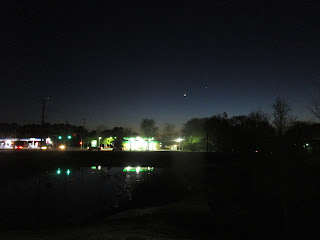
| A crescent Moon and a planet, probably Venus, seen from Lowes Grove after sunset in April 2018; a former Citgo gas station is on the left and a BP is on the right. © |
Despite light pollution being covered in Durham's UDO (Unified Development Ordinance
dsc.durhamnc.gov/175/Development-regulations
) it remains abundant and must be increasing. In parts of Durham a
clear winter night sky is black and sparkles with some of the
brightest and most well-known constellations and on summer nights the
Milky Way is just barely perceptible overhead, marked by the three
avian constellations forming the Summer Triangle, high in the sky, but
far fewer stars are visible than in rural parts of North Carolina,
and few if any places in the state are truly dark. Unnecessary and
wasted light can harm other species and human health and safety,
besides ruining the night sky and wasting electricity, largely
generated by polluting or otherwise damaging sources of energy.
When there are low clouds the problem
in Durham becomes more visible. One night several years ago, around
maybe 10 or 11pm, low clouds over southern Durham were intensely
orange, as seen from the edge of Chapel Hill, and I heard that people
called 911 thinking there was a fire. Circles of white light can
sometimes be seen reflected above Research Triangle Park and
commercial areas and when it is clear all of those photons still go
up into the sky, where they bounce off air pollution, dust, and water
vapor, making the sky brighter than it would be naturally, washing
out the stars. From fall through spring low clouds turn bright
orange for part of the night in one area. The source seems to be
brightly lit greenhouses at the Park Research Center (104 TW
Alexander Drive, apparently housing several companies, with the
entire complex owned by an entity in New York City), across the road
from RTP proper. The greenhouses are visible, an amber glow through
the bare trees, across South Alston Road and the Burdens Creek valley
from what is now called Falls Pointe at the Park (100 Cascade Falls
Lane off of South Alston, www.fallspointeattheparkapartments.com
see a previous post:
www.durhamspark.blogspot.com/2018/12/burdens-creek-bluff-and-surrounding.html
). The light pollution is bright enough that branches are clear in
photos taken with a plain digital camera miles away. At the
Stonesthrow Apartments, right next to the greenhouses, the reflected
light is so bright that it is possible to read a book by it. Surely
this has biological effects and pollutes the common night sky for
everyone over a large part of south Durham. Durham officials
measured the light levels, but as I recall the light is considered
indoors and therefore not covered by the UDO, despite the walls and
ceilings being clear glass, so the situation has continued for
probably more than 10 years. There are other large greenhouses in
RTP, such as at agribusiness company Syngenta on Davis Drive just
north of Highway 54 and I-40.
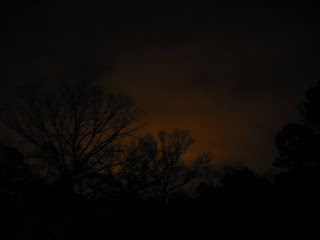 |
| The orange glow seen from a few miles away February 11, 2013. © |
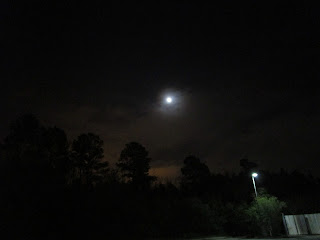 |
| The Moon and an orange cloud (and a light) seen from a CVS on Highway 55, closer than the location above. © |
At UNC, the Biology Department had a
small greenhouse behind Coker Hall, but it was replaced by a larger
one on top of the newer Genomics building, like a lighthouse at
night. The brilliant white floodlights over the sports fields along
South Road are intense, and are often left on when the fields are not
in use. Indoor lights are left on, despite older buildings
having signs on the switches, perhaps a response to the oil crisis of
the 70's (stemming from US and other “Western” imperialist
backing of Israel around the 1973 Arab-Israeli War), saying to turn
lights off when not in use. In at least some classrooms the lights
automatically turn off towards midnight, many hours after classes
usually end. In addition, large windows without screens are
frequently left open, such as at Hamilton Hall, even during the
winter so insects and other animals come in (and then traps are used,
the subject of a future post) and the heated or cooled air goes out.
Some windows and doors aren't well-sealed to begin with even in newer
buildings. UNC is supposed to be reducing its carbon footprint, but
I think it originally promised student groups that it would close its
coal-burning co-generation plant by now.
There is the bright orange light over
RTP and a less glaringly obvious bluish-white glow over Southpoint
Mall and the surrounding strip malls, car dealerships, and offices.
A recent study in Tucson, Arizona, which has centrally controlled LED
streetlights with full cut-off shielding (preventing light from going
upward), found that less than 20% of the light measured from orbit
was from streetlights (see a brief article in the March 2021 issue of
Sky and Telescope magazine). Sometimes sweeping beams of
light can be seen when it is clear, but they might not be permanent
features. The fact that cloudy skies are so bright (called sky glow)
is probably another example of light pollution, in this case
non-point pollution coming from thousands of small to large sources.
Next time snow or ice causes widespread power outages, consider how
bright it is at night. Why does the landscape look so well-lit, when
no sources of light are visible? Our eyes do slowly adapt to the
dark, but it still seems much brighter than it should be when lights
are off over a large area and the Moon and stars are hidden. I
notice this most when there is snow, but it might also apply after a
hurricane. There is ground level light pollution include glare and
visual clutter from sources such as area lights (UNC is full of
examples, as are gas stations) and LED signs (such as at the corner
of 54 and Blue Ridge Road at the State Fairgrounds and one near the
corner of Highway 54 and Barbee Road in Durham, which replaced a
plain sign removed during the construction of Pulte's neighboring 54
Station, but it might be less noticeable now with the new LED
streetlights; see the linked post), and light trespass into yards and
windows. Excessive outdoor lighting or light profligacy could make
people more rather than less vulnerable to crime and wastes
electricity.
Light pollution from human activity in
space is a new problem. Currently there is a lot of concern about
the launch of many new communications satellites, eventually to
number in the tens of thousands, by US SpaceX, British OneWeb, and
possibly by Amazon and others, to provide high-speed broadband
Internet access in places not served by terrestrial infrastructure.
These relatively small satellites, currently being launched, are
going into low-Earth orbit and therefore more visible than much
larger communication satellites in higher geosynchronous orbits,
though possibly the new satellites are not very noticeable in urban
and suburban skies. The number of satellites and their ability to
autonomously maneuver makes it difficult for astronomers to avoid
imaging them with telescopes. The satellites can be made darker and
it is possible to reduce the impact on radio telescopes, but these
measures are up to the companies and might not solve the problems. A
US law banning “obtrusive space advertising” is the only
regulation covering light pollution from space, according to an
article in Sky and Telescope magazine (March 2020). There is
a higher risk of collision and malfunctions with so many new
satellites, leading to more space debris, which is an increasing
problem, because even tiny objects traveling around the Earth at
tremendous speeds can disable satellites and threaten astronauts.
Recently the crew of the International Space Station had to prepare
to flee as a piece of space debris approached and satellites have
collided (Wikipedia
says the first high-speed collision was February 10, 2009, destroying
an active Iridium communications satellite, a leftover from a similar project
to provide connectivity from low Earth orbit).
SpaceX has claimed that its space-based
Internet service will pay for a corporate human mission to Mars. An
article in the November 2020 issue of Air and Space/Smithsonian
magazine ( www.airspacemag.com/
) discusses speculation that rather than just connecting the billions
of people worldwide who lack Internet access SpaceX will instead
serve the US military and that this is an area of US soft power
competition with China (specifically with the Huawei company).
According to Wikipedia the SpaceX project is already receiving
Federal subsidies to provide domestic civilian Internet access in
rural areas and has been successfully tested with US weapon systems.
The British government invested in OneWeb for its own soft power
projection. On the other hand, previous attempts to provide Internet
access from space have failed, so these new satellite
megaconstellation projects might not be completed.
For more information, see an article in
the March 2020 issue of Sky and Telescope magazine (
skyandtelescope.org/ ), covering the problems posed for optical and
radio astronomy. There have also been shorter updates and a related
article on observing geosynchronous satellites in the October 2020
issue. The article in Air and Space focuses on the business
aspect, with little mention of pollution.
A few decades ago there were ambitious
proposals to generate solar power in space and manufacture in orbit,
potentially reducing pollution on the ground and solving some of the
drawbacks of using solar energy on a large scale. On the other hand
I think the 1972 book Limits to Growth by the Club of Rome
projected that collapse would come even with access to extra
resources from space. Perhaps this could be called offshoring
industry to space, instead of where it actually went. In the 90's
Russia experimented with reflecting sunlight from space to light up
cropland at night. Several years ago orbiting solar powerstations
was discussed in the Raleigh News and Observer and one letter
to the editor talked about probably nonsensical 'death rays' from
space. In the original proposal energy would have been beamed to
collector stations on Earth as apparently weak and mostly harmless
microwaves, similar to radio waves.
Light pollution can have an impact on
the plants. Day length controls the seasonal life cycles of many
plants, and influences leaf form and root growth. Plants judge day
length by sensing red wavelengths, at intensities much less than that
required for photosynthesis, or for reading a book, and a short
period with light is enough to confuse them. Various plants respond
to day length differently, for example many houseplants ignore
daylength, because daylength does not vary much over the year in
their native tropical habitat, but confusion caused by indoor
lighting makes it difficult to grow some vegetables and flowers that
come from higher lattitudes indoors. Plants outdoors exposed to
artificial light could grow in the fall instead of preparing to go
dormant, especially vigorously growing plants or branches, and plants
exposed to constant light more readily suffer damage from air
pollution or drought. Trees can be seen producing new leaves in the
fall after a severe drought, though it is unclear to what extent this
is due to light pollution. I have seen tuliptree branches
surrounding a streetlight still with foliage in December, while red
maples and Japanese maples not so close lights produced new leaves in
fall following severe droughts, such as in 2019. There are nearby
silver maples that often retain some foliage into winter, though
silver maples generally seem to lose their leaves early, but again it
is not clear how much this is due to streetlights not far from the
trees. Occasionally trees try to grow in the winter for other
reasons, such as after severe injury and/or drought, and some
deciduous species are somewhat evergreen when young.
 |
| This young tuliptree next to a streetlight in Durham still had a lot of green foliage December 11, 2016. © |
Different species have different light
sensitivities. According to a forestry bulletin from Purdue
University trees such as boxelders (a species of maple), many
birches, hornbeams, dogwoods, American beech, tuliptrees, sycamores,
cottonwoods, black locusts, hemlocks, and American and Siberian elms
are among the most sensitive trees. High-pressure sodium lights most
impact plants, along with incandescent bulbs, unless they are low
intensity. Purdue recommends mercury vapor, metal halide, and
fluorescent lights, in order of increasing risk. Unfortunately these
blue-rich lights are very attractive for insects.
Many insects are attracted to light,
especially blue light, though not all insects or moths are attracted
to light. Low-pressure sodium attracts few insects, but instead it
can cause insects to rest as if it were daytime. Once insects or
other animals are drawn to lights, they waste energy needed for
survival and are more exposed to predation. Treefrogs often hunt
around porchlights and spiders spin their webs nearby, while bats
circle around streetlights. Some moths can hear bats and avoid them,
but mercury vapor lights somehow interfere with this defense.
 |
| A light left on overnight at the entrance to Jordan Lake State Recreation Area's Seaforth day-use area attracted many moths, including a rosy maple moth, dagger moths, and what seems to be an oakworm moth of some kind. © |
 |
| A large imperial moth and an unidentified underwing moth found outside a building at UNC; there was also a green June beetle. © |
 |
| Moth wings, mostly from luna moths, discarded by predators at Falls Lake State Recreation Area; the predators were probably aided by the park's lights. © |
A few years ago it was discovered that
a dung beetle navigates by the Milky Way, which probably has not been
possible over vast areas of the world for a long time, unless the
beetles have a way to see the Galaxy that humans lack. The Milky Way
seems to be an almost imperceptible glimmer in the Triangle during
the summer, at best. The Milky Way is in the sky all year, but if I
have seen it at all, it is only when the Summer Triangle asterism,
which includes a segment of the Milky Way, is high on summer nights,
and our galaxy might be visible as a barely brighter strip of sky.
Reportedly after an earthquake knocked out the power in Los Angeles
people were frightened when they looked up and saw the arc of the
Milky Way, though it was a familiar milky-looking glimmer in the night sky
throughout the existence of humanity, until several decades ago.
The media airs satellite images showing
the mostly dark, heavily sanctioned DPR Korea contrasting with the
brilliant glow radiating out of the ROK and northeastern China, but
while capitalist East Asian cities are spectacles to see (apparently
Hong Kong has been called the most light polluted city on Earth), all
that light represents wasted energy, probably generated by burning
fossil fuels or dams, and climate change is becoming more and more
obvious around the world and could ultimately burn us all.
Predators can benefit from artificial
lighting, but this upsets the ecological balance. In Switzerland when streetlights were
installed in some valleys, a bat that did not hunt at streetlights
went locally extinct while a similar species that could make use of
the lights made inroads, though light was probably not the only
factor. Large toads enter streets to hunt under neighborhood
streetlights on summer nights here, where they frequently get run
over. Apparently amphibian eyes can take hours to recover after
exposure to bright light, so they may be left blinded by passing
cars. It is probably well-known that coastal light pollution
confuses endangered sea turtle hatchlings, as well as disrupting the
vertical migrations of zooplankton, tinkering with the base of the
marine food chain. Commercial fishing actually introduces a lot of
light pollution far out in the ocean in some places, visible from
space. Many aquatic animals are attracted to light at night and
marine organisms use light to lure prey or startle predators.
Birds migrating at night, especially in
storms, are attracted to lights and crash to the ground after
collisions or exhaustion. Thousands of birds can die at once when
flocks of waterfowl mistake parking lots for water and try to land as
if on water. The Fatal Light Awareness Program (www.flap.org)
estimated that one to ten birds die per building per year, due to
collisions with glass or light pollution, and 100 million to one
billion migrating birds die each year in North America (this might refer only to the USA and Canada). People sometimes complain about
depredations by cats, but might be ignoring losses due to buildings,
windows, habitat loss, insecticides, climate change, airplanes, and
the increasingly powerful wind energy lobby. If birds and other
wildlife are killed by proposed wind turbines beyond the horizon off
the Outer Banks, how will we know? It also seems like marine life
would be disturbed by offshore construction, as it would be by oil
exploration. Like a full Moon, artificial light prompts birds like
mockingbirds to sing at night, with unknown impacts (see the link to
an upcoming webinar on new research below). Mammals generally avoid
lit-up areas, so lights could drive them away from habitats they
could otherwise inhabit (this might include bobcats, which are still
sometimes seen in the Triangle).
There have been few studies of light
pollution's affects on us, but artificial light at night may cause
cancer and could damage eyesight and is supposed to contribute to
sleep problems. Working at night is supposed to increase the risk of
various diseases. There are conflicting studies regarding crime, but
criminal activity is more visible with motion sensitive lighting than
continuous lighting. It would not be surprising if all the glare at
UNC increases crime and it detracts from the beauty of the campus.
The night sky is a commons everyone had
access to just by looking up, until air pollution and light pollution
became abundant, another example of business dumping its
externalities and abusing or expropriating the commons for private
use, though in the case of light pollution we also do it to ourselves
on a smaller scale. The starlit sky was important in human development, though things are much more abstract now, so religious
ritual is conducted indoors, abstracted and estranged from our
natural environment; astronomers don't have to observe at night; and
the heavens are now a destination for tourism, neoliberalism, and
warfare. Despoiling a lifeless celestial body like the Moon might
not be the same as despoiling the Earth's living biosphere, but
damage to the environment, our common cultural heritage, and Space
Age historic sites on other worlds is still likely. US space policy
under Trump, Obama, Bush, etc. seeks a cosmos under neoliberalism and
imperialism. At state parks in rural eastern North Carolina, such as
Jones Lake, there is little light pollution and the sky is so full of
stars that it can be hard to recognize the constellations, but these
are still not primordially dark skies. Amateur astronomy groups from
the Triangle have to travel to places such as Medoc Mountain State
Park to find relatively dark skies. Jordan Lake has darker skies
than Durham, but the Milky Way is still obscured.
Fortunately there are low-hanging fruit
on the path to restoring the night sky. Lights should be shielded so
they only shine downward and turned off or dimmed when not in use,
though a large percent of light still reflects off the ground and
into the sky, such as at the vast and empty after hours parking lots
around Southpoint Mall and neighboring strip malls. Outdoor lights
should be checked regularly to make sure they stay correctly aimed.
It is helpful to organize residential outdoor lights in separately
controlled zones. Designers recommend beginning with less
illumination than you think you need, to avoiding putting in too
much. If a transformer is necessary, factor in how many lights you
might connect to it when deciding on wattage. Lights might be placed
around pools for safety, but fish are not immune to light pollution
and can sense electromagnetic fields. Use high-quality fittings,
especially for more exposed low-voltage systems. The International
Dark Sky Association ( www.darksky.org
) has recommendations on design and specific
fixtures.
Exterior lights require much less
intense wattage than interior lights, and soft lighting usually looks
best. Low pressure sodium bulbs minimize light pollution, but they
produce monochromatic yellow light. An increasing problem is
blue-rich white light (BRWL), produced by otherwise
environmentally-friendly LEDs. Our eyes are especially sensitive to
blue light, so we perceive more intense pollution from them (consider
how blinding oncoming blueish-white car headlights are), though this
light transmits a shorter distance through the air than redder light.
BRWL lengthens the time necessary for our eyes to adapt to darkness
and is less visible to the elderly. Warm white LEDs (less than
3000K) are a better choice.
At the start of the pandemic last
spring the City of Durham was still able to send teams to install
about 21,000 LED bulbs, apparently energy-efficient but producing
glaring, probably blue-rich, white light, on existing and new
streetlights, and the number of streetlights alone (mandated by the
UDO in new construction) was already a problem in some neighborhoods. These LED bulbs could be the reason why it seemed like more cicadas than usual were being attracted into the street at night and often killed last summer. Recently I noticed that the new traffic circle at the intersection
of Herndon and Barbee roads seemed to be tinged blue or even violet,
though the effect might have been heightened by yellower lights
leading up to the intersection.
Durham's streetlights might have become
more energy efficient over the decades, but it has also gotten ever
harder to see the stars without traveling some distance, and then
there is the chance that people will be suspicious or even call the
police. Neighborhood parkland where I watched meteor showers and saw
the bright comets Hale-Bopp and/or Hyakutake has since been marred
with a streetlight, though the area is supposed to be closed at
night. I have suggested, without result, to the representatives of “developers” and
officials that they could create dedicated places for people to
stargaze, such as where there are ridges or lakes offering good views
of the entire sky. Some public lands in the Triangle are open 24
hours a day, but they are often somewhat distant and there still might be
dangers in going there to see the night sky.
Reportedly people can request extra
shielding on treetlights in the City of Durham by contacting
transportation specialists Terry Thompson or Denise Warren at 919 560
4366 ext 36407 or terry period thompson at durhamnc period gov or
denise period warren at durhamnc period gov durham and they will send
the request on to Duke Energy. People can request the removal of
offensive streetlights, but the Durham Police Department gets a veto.
A few years ago Trump brought up some
of the obvious problems with new forms of lighting, but advocated
going backwards to inefficient, and therefore polluting, incandescent
bulbs instead of looking for new ways to combine efficiency and
aesthetics. Red light is supposed to be less harmful to human
nocturnal vision. Perhaps lights could be designed to be less
visible to wildlife, smart enough to activate only when needed, and
more efficient.
Virtual LUNCHBOX Talk: Analyzing the
Effects of Urban Noise and Light Pollution on Avian Communities
NCSU Master of Science student Lauren
Pharr will talk about the impact of anthropogenic noise and light
pollution on area birds in a webinar February 25th 12 –
1pm, organized by the NC Botanical Garden and the New Hope Audubon
Society. The Botanical Garden offers a Lunchbox Talk on conservation
topics every month. For more information and registration see:
ncbg.unc.edu/learn/
Proposed rezonings in southern
Durham County and the City of Durham
Also related to the post linked at the
beginning, there was a community consultation meeting via Zoom
Tuesday, January 26th 6 – 8pm about the hundreds of
acres owned by the Triangle Brick Company west and south of the
intersection of Highway 55 and Hopson Road. “Development”
interests, typically represented by lawyers and/or engineers at these
legally mandated meetings, want to have this vast area (I think the
figure was 241 acres and it is probably roughly a mile or even more
from east to west) around the abandoned claypit, extending from both
sides of 55 to within view of Grandale Road on a ridge, much of it
already clearcut several years ago, rezoned to be all Light
Industrial (some of it is currently Rural Residential) and annexed by
the City. The proposal is a business park, ultimately with 5 to 6
short office or industrial buildings, similar to those at the corner
of Hopson and 54, with staged construction beginning in the spring of
2022. Of course if a site is rezoned without a development plan,
something else could be built, if consistent with the zoning.
Another large chuck of land west of this “assemblage” was
clearcut a few years ago, and it seems like it is only a matter of
time before it will be sold and built on. These are some of the last
large tracts of undeveloped, rural private land surrounding the
Wildlife Resources-managed gamelands around Jordan Lake at the very
south end of Durham County. This Federal land as well as some owned
by Durham County covers bottomland that can be inundated when the
Lake is used for flood control, and doesn't protect much of the
higher ground. Some species need both lowland and upland habitats,
such as many salamanders, and others might live in bottomlands only
because the uplands have been made inhospitable for them by sprawl. Not far south of
the countyline there have been vast changes as residential sprawl
around rapidly growing Cary in Wake County spread into northeastern
Chatham County, formerly remarkably 'empty,' except for a few houses
and older subdivisions (maybe these would be called exurbs), with
vast expanses of relatively young forest, some of it held as private
hunting reserves, inhabited by flocks of turkeys, possibly bobcats,
etc. Rarely seen bobcats might be one of the mammals that can be
driven away by artificial lighting. Today the area is almost
unrecognizable, with old roads renamed or rerouted, two lane roads
have become wide enough for many lanes, and much of the forest and
old houses were scraped away, creating a lunar or martian landscape
during construction. For years there have been yard signs nearby
saying 'no' to Cary.
 |
| Looking roughly southeast from the powerline at the northwest corner of the site in 2012; this is only part of the "assemblage" and is now a young pine forest. ©
|
 |
| The intersection of Hopson Road and NC 55 at the east end of the site, which includes the wooded land in the background and some on this side of 55, to the left. © |
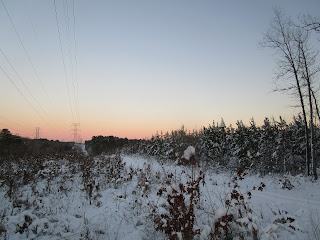 |
Looking
east from the northwest corner in 2018; most of the land on the left is
owned by the US government and Durham County; NC 55 is out of sight
behind a ridge far down the powerline and the old claypit is behind
the forest in the center. © |
There will be a meeting Thursday,
February 18th 6-8pm about the 40 acres of Durham
County-owned land at 451 TW Alexander, 6001 NC 55, and 6026
Experiment Drive/Avenue. This is where a large hill was blasted away
several years ago for a failed commercial or residential project, the
earth being used as fill for North Carolina's first toll road, part
of the ring of 540 around Raleigh (construction which could harm the
endangered dwarf wedgemussel in southern Wake County). Apparently
excess material from the hill was dumped in the claypit. Nearby
roads were re-routed and a new road built, near the colony of
pinxterflower azaleas, as well as deep red, five-petalled fire pinks
and other common to very rare wildflowers around a former farm. The
area is probably unusual because of the presence of igneous rock
formations, unlike the typical sedimentary bedrock in the Triassic
Basin of southern Durham. I last heard that the County wanted to
build something like a sludge-drying facility for the nearby Triangle
Wastewater Treatment Plant, but the neighborhood meeting is about
rezoning to Office and Industrial (parts of the site are currently
zoned for residential, commercial, and office use) for “a new
Durham County Public Works Administration Building.”
 |
| The site in 2010; there was a wooded hill with a house here and this is about where the driveway was; the Triangle WWTP is lower out of view on the left and there is now a residential development on the right, across TW Alexander Drive. © |
Community consultation meeting
information and other planning-related announcements are sent out
every Friday through the Planning Public Notification Service of the
Durham City-County Planning Department ( sign up at
durhamnc.gov/411/Planning-Public-Notification-Service ). Those
owning land within a certain distance of a proposed rezoning receive
legally mandated notifications by mail. There is a link to join the
meeting via computer or phone, but it is not working: dtwarchitectsandplanners.my.webex.com/dtwarchitectsandplanners.my/j.php?MTID=m687db88b818ca d7daefa13e28c13a1bf To join by
phone, call 415-655-0001, meeting ID 142 953 5347.
There will be meeting 5 – 7pm
February 18th about rezoning 2102 So Hi Drive from Rural
Residential to Science Research Park, to build two office buildings.
This is a large piece of land at the corner of So Hi and Northeast
Creek Parkway, bordering RTP. The site is on the south (RTP) side of
the intersection, extending from the Triangle Curling Club on the
east to about an equal distance west, on Northeast Creek Parkway.
The owning entity is Parmer Woodlands 3 LLC, with an address in
Carlsbad, California, and similarly named companies with the same
address own large parcels adjoining 2102 So Hi and on the west side
of the intersection, making up most of the north end of RTP.
Northeast Creek flows through 2102 So Hi, and is joined by a small
stream flowing from the north that crosses So Hi in a narrow valley
by a church. Beavers have been very active in the area and this
might be where there is or was a very large, though shallow, beaver
pond, between a ubiquitous sewer easement and a high-tension
powerline. Fish probably include pickerel and bowfin and would be
hunted by belted kingfishers. Other ponds can be seen from Northeast
Creek Parkway. Durham's Interactive Maps (
durhamnc.gov/1455/Interactive-Maps) shows a large body of water
there, though maps are often inaccurate regarding waterways.
Fire pinks, pinxterflower wild azaleas, evergreen Catawba rhododendrons, more than one species of dogwood, umbrellatrees (a deciduous magnolia,
blooming around May 1st here; fire pinks might also bloom
in May, while pinxterflowers bloom in April), spicebushes, milkweed,
burdocks, Hepatica, star chickweed, toothworts, liverworts, and horsetails are some
locally uncommon to rare plants growing in the general area. Nearby
areas are carpeted with spring ephemerals and some, such as lavender Hepaticas, could be blooming already and can start around January if
it is a 'warm' winter. Hawks are common, phoebes nest along the
Creek, and upstream hummingbirds fight over summer beds of orange jewelweed.
The usual procedure is for the rezoning or annexation applicant to
have one or more informal community meetings, followed by a formal
hearing before the Planning Commission, and then a hearing during a
regular City Council or Board of County Commissioners meeting.
To join via Zoom, go to zoom.us/join, meeting ID 884 8173 7483,
passcode 450403, or call 646-558-8656 and enter the same ID and passcode.
 |
Looking
north on Northeast Creek Parkway; Northeast Creek parallels the road
on the right. © |
 |
| A Hepatica off of Grandale Road in late March. © |
 |
| Hepatica with fresh new leaves, trout lilies, spring beauties, Christmas ferns, and probably some star chickweeds in early April off of So Hi Drive. © |
Third party ballot access in North
Carolina after 2020
The NC Green Party lost its hard won
ballot access with the 2020 general election, with campaigning and
petitioning hobbled by the pandemic. Without ballot access Greens
running for office will have to get on the ballot individually or
run as write-in candidates and will not be listed as Greens and
voters will not be able to register as Greens. The NCGP is asking
Governor Roy Cooper to maintain the Party's official status and/or to
maintain the status of registered Green voters for 18 months; waive
petition requirements for all parties that had ballot access as of
2020 (the Constitution Party apparently also lost its ballot access
last year); and to lower the required number of signatures to
establish or re-establish a party by at least 75% and to allow
electronic signatures. The pandemic severely limited campaigning last year
and makes petitioning hazardous, and there aren't gatherings where
people could be asked to sign in-person. Greens plan to run in
several local elections in 2021. For more information, a sample
letter, and to sign up to send a letter or email, go to:
www.ncgreenparty.org/ask_cooper_for_covid_relief
RDU Quarry Town Hall with NC Senator
Wiley Nickel
There will be a town hall meeting about
the proposed rock quarry at the RDU Airport, adjacent to Umstead
State Park, Wednesday, February 10th 6 – 8pm with Wiley
Nickel of the NC Senate and Dr Jean Spooner of the Umstead Coalition
( umsteadcoalition.org , www.facebook.com/umsteadcoalition/
. To sign up and submit questions see: forms.gle/78F8oVdBE7e9hrKy6


 Posts
Posts


